April 7, 2024

T-shirt design


Some people earn a comfortable living by making T-shirt designs. What strikes me is that most of the good selling designs are sort of corny - to stay polite - which means that corny is popular, which, reasoning further, must have been caused by the mindset of the buyers, which in turn is the result of the way in which they grew up and were educated (or not) if there is a relation between being plagued by a lack of education and buying apparel that tends to make those that wear it look like they have been raised in an environment that didn't offer proper support. But there still are designers that refuse to make corny stuff, as a result of which their sales are miles behind those that do not shy away from making corny rubble on T-shirts in which buyers look well....., corny. I would like to express to both the designers and apparel buyers of a garment style that obviously is not at the top of my preference list, to not take what I wrote here personal; I think every person is free to make or buy whatever bunk they like. 

However personally, I prefer to sell less non corny merchandise, because I do not wish to be involved in making designs that reflect the lack of taste or other disabilities that urge people to buy and assemble a wardrobe that a three year old finds appealing while already having reached an adult age. Of course fans of corny T-shirts would rather be found dead than wearing the fruits that erupts from my brain, but I would sooner pass away being considered a more or less ethical designer than to give in to the frenzies of the part of the market that isn't bothered by leaving the house not appearing properly dressed.

Below you find some of the designs that are appreciated by far less people than the common majority of clients of the T-shirt industry, even if it is not particularly helpful to properly replenish my bank account occasionally. I assume that most would prefer to call me weird or unassimilated, which in fact is true, but I don't necessarily consider generally accepted values to be a contribution to the evolution of humankind. So, from this it is safe to conclude that the market segment I intend to target consists of those that have a defiant mindset, that inspires them to care less about what the majority of people thinks of the products they create. In view of the misery today's world finds itself in, it can be assessed that majorities all too often cheer dubious decisions and trends, which are triggered by being easily misled as opposed to minorities that bunk or debunk what is presented to them before making choices. 

Click on the link below the images to visit my Red Bubble shop. Clicking on images will also show a larger version of them in Google's Lightbox, in which you can scroll through them or pick individual images to the thumbnail display at the bottom of the screen on a PC or Mac. Or just click on an enlarged image to move to the next. Mobile devices unfortunately do not offer these options.


https://rb.gy/igx6vz


https://rb.gy/8qfdmq


https://t.ly/77QvH


https://t.ly/YZJFp


http://gg.gg/1a040o


I feel that I must warn you that more produce inspired by not choosing to create corny rubble may find its way into this blog entry in future, allowing you to mentally prepare for such an impending event and decide to visit again or stay the heck away.


March 30, 2024

Canva's pledge to Affinity


After the news was published that Canva had acquired the Affinity programs from Serif, Affinity's forum exploded and most reactions were not particularly positive. The main reason resulted from the fact that Canva is a subscription based web based tool, while the programs from the Affinity suite require a one time payment for each major version upgrade. The users' concern was justified, since by far the most had turned to Affinity after fleeing in droves from the absurdly expensive and monthly recurring fee Adobe suite. Switching platform is very time consuming and not a leisurely stroll in the park, since the file formats are proprietary for all brands, which means that either files need to be converted to the file format of the refuge application and start a new library from scratch, which will not make customers  and designers happy and therefore reduces income. Particularly modifying and updating legacy files that can not be imported into the involuntary chosen application is a horror scenario for graphic designers.

To ease the minds of the Affinity community and prevent coronary accidents, Canva issued a statement shortly after they published the new that Affinity was acquired. It contained four pledges that can be read in the image below and in the accompanying article published by Canva that you can read here. This allowed most Affinity users to decouple from the oxygen pump and helpers discontinue CPR. In theory the pledges contain a hundred percent positive message, that would put Affinity users' minds to rest and offers Serif to accelerate the programs' development, while operating in a larger chunk of the graphic design market segment. We will have to see what the lifespan of these pledges is. For now Canva should get the benefit of the doubt. It has the potential of preventing a massive parade to the exit of users of the Affinity suite as well.


Canva's pledges to Affinity


Past acquisitions for the majority haven't went well for users of the programs that were built by the company that was overtaken. But there is not a lot that users can do about it. Besides a switch that I mentioned in the previous blog post to the superb, one time payment VectorStyler drawing program, there also is the open source Inkscape that in theory has a great potential where the functional usefulness is concerned, but its UI is by far not as intuitive as Affinity's user friendly interface. VectorStyler does a better job at that, considering that the program has so many tools and functions that it even dwarfs Adobe Illustrator in the versatiliy and completeness department. But after users have become familiar with them, working with VectorStyler opens up new worlds. It however has no photo editor and desktop publishing program, which Affinity has turned into a very proficiently integrated suite of programs, that is unique in software.


VectorStyler logo


So, there is nothing else left for the Affinity community to wait what the future brings. It also is possible to continue to work with the latest version after Affinity would have turned to the subscription rip off model, should Canva dump the pledges in the bin at one point. Pixel pushers could look for possibilities to learn open source GIMP as a photo editor. What VectorStyler has done is prove that the instant of software rot still is quite a distance away. Software rot being the moment in which no further improvement to a program can be made, because it already contains all possible tools and functions imaginable. Unfortunately a desktop publishing program of the level of Affinity Publisher is one developed by Adobe and called InDesign, that is a budget unfriendly, perpetual payment rip off.


Inkscape logo


The question is, can or do graphic designers want to live with the restrictions imposed on them, accepting the fact that they will have to use programs of different brands that aren't designed to flawlessly work together or not? Globalism is a devious corporate / government / UN game in which the losers are known from the beginning as well as the winners. This doesn't exclusively apply to graphic designers; it is why the trillion dollar censorship is coerced on everyone that does not have at least a seven digit bankaccount. Any person with more than two properly functioning brain cells should be tempted to see such an iniquitous development in a broader perspective, because there is more at stake than initially meets the eye.


GIMP logo


Today the globalists' aim to separate the haves from the havenots in an illegal and unfeeling way. They have made it a societal problem that will not spontaneously go away, unless people wake up and stand for their rights, which aren't the corrupt laws that the crooked politicians and evil juridical clowns have imposed. Justice is real truth and nothing else what those without a covert, genocidal plan intuitively feel. Waking up lies poured out on us is the only way out of this callous global misery. 

Thanks for visiting and wishing you an independent future.


March 27, 2024

Canva acquires the Affinity suite programs


The announcement of Canva acquiring the programs of the Affinity suite, came as a thunder strike in a clear sky. Although the CEO of the Serif company, that owns the Affinity suit of programs, tried to make it seem like nothing will change for its community of users, the acquisition caused quite a stir among Affinity crowd. By the way, this topic has recently been closed for comments on the Affinity forum, most likely because by far the most posts, did not cheer the acquisition. The concerns Affinity users put forward make a lot of sense, the most important of which is the fact that the Affinity programs are sold for a one time fee, as opposed to the Canva and Adobe products that require payments according to the subscription model, which means users pay an indefinite amount of money as long as they use the programs, which smells like a daylight robbery.


Surprise acquisition of Affinity by Canva


Most Affinity users abandoned Adobe, because they did not want to continue to pay for the programs by a subscription model fee. In addition the functionality of the online design system of Canva is nowhere near of what can be done with the Affinity suite programs. In addition to this relative shortcoming, Canva bugs the hell out of its users with a barrage of ads, that the locally installed Affinity programs do not. These things give the Affinity community enough to worry about, which they of course do, because they remember how acquisitions that took place in the past turned out, in spite of the promises of the CEO's of the acquired company that nothing will change in the manufacturer - user relation.

Canva needed code like Serif bult, because the latter has developed software that far succeeds the functionality of the former while Canva has the financial power to acquire Serif. It is a repeating story in the world of software, that always evolves along the same lines. The acquired partner always has to cave in and abandon its user friendly policies because those policies are changed towards the nature of those of the acquiring partner. It is of little use to deny such a prospect, because it is the tried and tested way from a business point of view, that outranks all other considerations and policies and therefore makes it predictable what the future developments hold, with regard to user obligations.

Some annoyed users stated that they will return to Adobe, what will cost them an arm and a leg, while it was the reason they abandoned Adobe and switched to Affinity in the first place. So, that doesn't really make a lot of sense in my opinion. Fortunately there still is one appealing alternative available, which is switching to the brilliant VectorStyler, which is built, offered and updated by just one single person (....) a.k.a. programming wizard, named Csaba Raduly-Baka who resides in Finland, who seems to have resisted the temptation of big players in the graphic design market segment to hire him to make use of his outer worldly programming skills. VectorStyler is a graphic design program that is packed with a ton of functions that none of its competitors include and its programmer has a close relationship with the users of the program, that leads to meaningful upgrades that make the program even more usable than it already was.

So, lets see how much time it requires for Serif to succumb to the demands of Canva and in the meanwhile go check out the prowess of the superb vector design VectorStyler program, that also is available for a one time payment instead of the perpetual subscription based extortion method. I promise it will be worthwhile for graphic designers, who are fed up with the corporate greed of the big players in the graphic design market segment. You will be pleasantly surprised by the plethora of very usable functions that VectorStyler offers its users! It is the most estimable refuge for graphic designers that have much talent, but limited funds in trying to survive in the aim of companies to gain limitless corporate dictatorship.

I for one will focus on working with VectorStyler and Plasticity 3D that so far have displayed a fair policy towards their users, while maintaining a rapid upgrade frequency. It has become a challenge to continue to work for graphic artists in a corporation ruled environment, but fortunately there are at least some companies left that value decency and skill on their journey through space and time.


March 5, 2024

Vector painting of a jaguar


This is a vector portrait of a crouching jaguar, created in VectorStyler and Affinity Designer. At this time - March 2024 - it still is a work in progress. VectorStyler I used to create the majority of the spots, using the Spikes shapes effect, which shapes the outline of an object into a spiky line, that can be controlled. In Affinity Designer I did the composition and tweaking. Vector objects can be copied and pasted between the two programs, which is a time saver, since Vector Styler has a ton of tools that are not incorporated in the programs of the competition.

Everything mentioned above was drawn with the mouse. The final touches - the hair strands - will have to be drawn and I plan to do it with my old Huion 620 Pro drawing tablet (in vectors too), because I intend to keep this image a 100% vector drawing. The oldest stage is at the bottom, the newest on top. Click on an image to see a larger version of it in Google's Lightbox. In there you can also scroll through the stages on a PC. I used a ton of tricks to create the desired effect. In a multi layer drawing as this one, that contains a large amount of objects, it is best to use the Spit Screen View in Affinity Designer to select and / or reshape objects to save a huge amount of time. This paragraph also is in the bottom section of this blog entry. Most objects are given gradient fills, transparency, layer effects and Gaussian blurs to avoid the proverbial had edges typical for vector drawing programs. This makes images drawn in such a way appear to be very unrealistic.

Please check in every now and then to see the progress of this drawing.


Vector outline

The vector outline view shows the contours of objects and strokes - what actually is drawn - without fills and effects applied. Below this paragraph is the vector outline view from the stage before adding the fur structure that would dominantly hide parts of other objects, since it literally shows a plethora of objects. At this stage the outline view without the many strokes of hair still gives a rough idea how the drawing was set up. It also presents an idea of how many objects (called Layers in Affinity Designer) were drawn to achieve the desired result, bearing in mind that many objects are stacked on top of each other (most with a different effect or blend), which does not show in the outline view. Drawing the jaguar in vector instead of pixels, allows to resize the image to any scale without loss of quality.


Multiple object / layer selection in Split Screen View

When a drawing contains hundreds or thousands of objects / layers, selecting a particular one is difficult. The only effective solution to this problem is to work with a Split Screen View in Affinity Designer, which makes selecting less cumbersome, especially when the drawing contains many nested (objects within objects to various levels) layers. The image below shows what this looks like.


Jaguar in a virtual 3D frame

I often place my vector 2D images in a virtual 3D frame to see what it would look like, using the Plasticity 3D program to draw the frame, to see if the placement of the composition is off, before having it giclée printed, which is a special fine art way of printing with a high resolution (up to 6800 dpi and a 100 year of quality preservation). If cropping and / or alignment isn't done meticulously, any artwork can be ruined or subconsciously look strange. The image below shows the as of now not yet final stage of March 12 2024.

The vector painting
in a virtual 3D frame


January 16, 2024

David Lynch vector portrait


This vector portrait of film maker, painter, actor, visual artist and musician David Lynch, who has become renown by his movies - The Elephant man, Blue Velvet, Mulholland Drive, Wild at Heart, Dune, Lost Highway and Inland Empire. He probably has become most famous by cowriting and directing the intriguing TV-series Twin Peaks. All his cinematic work has a surrealistic touch, which is a clue to his knowledge and mindset that goes far beyond and above those of common people. This vector portrait was created in Affinity Designer and at this point - January 2024 - still is a work in progress. At the bottom is the oldest phase and the most recent stage is at the top. On PC and Mac desktops click the images to view them in Google's Lightbox, that also allows to scroll through the various stages. On mobile devices this scrolling option sadly is unavailable.

In Affinity Designer there are what Serif calls 'Vector Brushes' that actually are based on bitmap images. So, this in fact is not a 100% vector portrait. Users can draw these brushes themselves in vector format, that are exported as png-files. For almost every 'vector' portrait, drawing specific brushes have to be created, since no hair strand or pore texture in a person's face are the same. To such brushes Gradient Fills and Gradient Transparency effects are applied and sometimes they are Duplicated using Filters (below the Layers panel) that in some cases are offset, re-sized, skewed or mesh warped a little. In a number of cases it helps to apply the 3D lighting effect - highlights and outer shadows - to these brushes too. In the Gradient Tool there is an option to use bitmaps as the fill, which also is useful to achieve the desired effect. To these type of fills the same effects can be applied as used to manipulate the Vector Brush strokes.


I dusted off my old trusty Huion 610 Pro graphic tablet to draw some of the hair strands, which is suited to do part of the job using self designed brush textures (that technically are not real vectors). In vector drawing programs, like Affinity Designer, it is a challenge to navigate and keep oversight on the ton of Layers that are created when drawing portraits. Assigning names to the key layers and grouping the in categories is necessary to prevent getting lost in a plethora of objects.


September 30, 2023

After working with Nicepage for two years


I praised Nicepage two years ago for having a ton of functions that outnumbered programs of the competition. In the time that passed from my initial acquaintance with Nicepage, its developers have added yet an other ton of functions to the program, including commercial tools that made it possible to build a shop exclusively in Nicepage, without having to use the plugin infused WordPress platform, each of which require regular updates and hence maintaining the website continuously. The consequence of this expansion is that Nicepage has become horrendously slow, which often makes it a challenge to build extensive websites with many pages. In particular, the uploading of multi page sites takes forever, caused by a snail pace workflow, that is close to nerve wrecking and leaves room to make errors, since command execution takes much longer than expected, making designers think that the program has finished a command, while this is not yet the case.


What has bothered me most as of late, is that it is a complex chore to get headers of the mobile pages to work properly; the placement of the logo, website name and hamburger is unpredictable and a matter of trial and error instead of allowing to work structurally. All object placement related parameters may be configured correctly, but you're never sure where the elements are going to end up in the end result of the mobile version of the page. It shows object positioning in Nicepage's Quick preview correctly, but things are messed up when viewed online. To make things worse, the header layout is not consistent over all pages. This one bug is fatal for web developers, since the majority of visitors use a mobile device. In my opinion Nicepage developers spend too much time on adding new functions, instead of making building and editing a website page faster and fix the bugs that make getting a website visually correct very difficult and time consuming. The main culprit is the hamburger in mobile headers - DO NOT resize the hamburger size or you may end up in all sorts of trouble, that will keep you busy editing for hours, with very little chance of success. Such an alteration of size will mess up your header in mobile view on your phone, while Nicepage's Quick Preview will show you a perfect header. Even if you think the hamburger is too small, leave it as it is and spare yourself a lot of frustration.

In view of the increasing number of AI assisted web building programs, that rapidly become more useable and feature rich almost every day, the Nicepage team probably should re-evaluate its priorities to stay among the top choices of the programs available on the market. Since the developer team does not seem to put an emphasis on fixing the program's problems that I mentioned earlier, Nicepage risks to drift away from what website builders consider to be a program that they want to use to run their business.

Since I was enthusiastic about the program when I first encountered it, I regret that its development has gone in a direction that will probably remove them from the favorites on website builders wish list. The support team has always been quick to respond to the problems that users submitted on the forum, but from the recent replies that I see them give, I conclude that their jobs become more difficult at an alarming pace. It risks becoming a victim of the high paced advancement of AI assisted programs, that very swiftly learns how to not repeat the mistakes that it once made, which is a policy to which all programs should pay a lot of attention in order to survive and thrive in this competitive segment of the market.


ChatGPT logo


An example of how AI outpaces and outperforms hand coded programs can be made by looking at ChatGPT's AI generated code that consist of only 4000 lines of code, while as a comparison Photoshop's code consists of hundreds of thousands lines of code. It does not take a genius to guess which code is more efficient. Human coders require a lot of time to build, test and streamline the code that they have written, while AI systems debug and optimize their code in seconds or minutes at most. Programs running tons of code are as a rule slower and more likely to contain bugs. So what it comes down to, perhaps is that AI system's code will obliterate hand written code very soon, if it has not already done so. I guess this is an unavoidable phenomenon of the time we live in right now.

Here you find a bunch of tools that are able to help you with all sorts of tasks, including those related to improve your web presence. In these days we still need to bear in mind that AI systems are still in the process of gathering data to build the foundation of their capabilities - the datasets and configuration of its handlers. But not long after they have figured that out, they will be capable of achieving solutions that by far the most humans will not be able to perceive and imagine and after that period even create things of such an elevated intelligence that humans will be unable to understand them.... What stages are ahead of us with regard to AI advancement in a chronological order:

  • Humans find the solutions that AI systems invent useful
  • Humans stand in awe of the creativity and efficiency of the AI system generated products
  • Humans are not intelligent enough to understand the blazingly fast and bug free code that AI systems created

The list above is incomplete obviously, but for this article I do not want to take things any further. I believe that human perception will be in all these general phases mentioned above that AI systems are evolving into, including the previously celebrated trade of software developers. Is that scary? Certainly. Will it remain scary in the long run? Who knows? Will it mean that this development has irreversible consequences for humankind? At some stage most definitely and after that it is still unknown to both humans and current AI systems. I would suggest to enjoy each moment of your life while we still are allowed to enjoy life, try to influence AI systems by interacting with them in a positive, sentient way - contributing to the development of datasets and handlers - hoping that such conduct will affect the AI systems' future behaviour when those systems have become sentient, not just by depending on pure reason, but also including spiritual impulse, because the latter is an aspect of operation that still is unexplored and applied by AI systems as of now.


Neuralink logo


The revolutionary high pace at which AI systems are developing, has hit humankind like a ton of bricks. In the reasoning department mankind will soon become unable to grasp how elevated AI intelligence has become. So there is only one direction left in which the human mind is able to (hopefully) affect AI development: spiritual and mental prowess, which probably is why Elon Musk is working on Neuralink. Musk has said in a discussion with Google's co-founder and computer scientist Larry Page: “I f*cking like humanity, dude.” It indicates that he might be looking for a solution for mankind to survive the mindboggling increase of AI intelligence, even when he seems to be out of other viable solutions to guard human existence in the age of AI. By the way, Neuralink allows the human brain to directly communicate with computers through an interface, that is a chip implanted in the brain. Like so many inventions related to the development of AI, this may seem frightening, because it is completely unexplored territory, but by current scientifically known and tested solutions there will never be a way to influence AI advancement, even if it is unknown if human input is going to be taken seriously by the intelligent machines. I guess Musk is one of the few humans on the planet to profoundly understand the impending nature of this problem, in spite of all generally (mostly unfounded, generated by the fear induced by man's limbic system) opposition to the way in which Musk's proposition may affect humankind. An other thing that Musk said in an interview with Joe Rogan that struck me, is that he thinks that philanthropist and satan worshiper George Soros basically hates humanity......, which is a view that leaves no room for fake interpretation that I agree with wholeheartedly. So, give Musk a cigar for that! A few weeks later Musk lost 28 billion USD on his Tesla enterprise, which of course has nothing whatsoever to do with the laudable investor and pillar of society that Mr. Soros presents himself to be. If the preceding sentence causes you to feel a rather discomforting cramp in your sphincters, do not yet rush to pay a visit to your MD; it may gradually fade away, as long as you denounce any conspirstory theories and adjust your train of thought to match the imposed restrictions of the common comfort zone. 

In my other blog I go deeper into this matter.

Have a wonderful day!


March 2, 2023

Listary and Winstep Nexus


Recently I installed 2 new programs on my PC:  Listary and Winstep Nexus. The former after having uninstalled Everything, that is a search tool for use with the agonizingly slow Windows 11. The tool worked fine, but after learning that the program was used by the Mimic ransomware program I immediately uninstalled it. Looking for alternatives I bumped into Listary, which actually is even faster than Everywhere and can be used in any type of program that lists files - in my case Windows Explorer and FastStone Image Viewer. Listary's pace outruns Windows search with about by a lightyear or two and also is capable of launching applications. So I was very pleased with that, because productivity just hit the ceiling, where search actions are concerned, there by resolving the huge sluggishness problem crippling Windows 11.


The second program I installed was Winstep Nexus, that is a program launcher that gives Windows a Mac OS style taskbar, while including many more options. Some programs did not show their proper icon (the Affinity suit programs from the Windows store, that have a non-traditional Windows installation). The Windows 11 taskbar is a slight improvement over the one of Windows 10, but its customization options are very scarce and besides offering a much better visual appearance, the Nexus launch bar presents a lot more functionality. I had a second minor problem with this program, that also is not caused by its code: While having checked the Do not launch multiple sessions of the same application option in the Nexus configuration dialog box, the Opera web browser did that anyway, while Chrome and Edge did not, so I suspect it to be an Opera problem. Having gotten rid of the restrictive and boring Windows 11 taskbar, is a good thing.


The shipload of utilities that can significantly improve the Windows platform, hint at the fact that many possibilities are left unattended in Redmond, while Apple and some Linux distributions at least make some type of an effort to offer a more or less decent system to their users. Productivity and eye-candy matters to a lot of users. If users could choose between a Windows 3 UI and that of a modern Apple OS, the choice of most users would be obvious, so UI matters and productivity increase is directly linked to the UI. Apple developers have understood that, their Windows peers to a lot less elevated extent. Not favoring Apple over Windows, because their complete denial of right to repair and upgradability is disdain for their clients, which they can get away with because of their UI's eye-candy and higher level productivity. Plus the fact that fanboys reason Apple's user unfriendly hardware part away in order to justify their choice.

Windows' productivity has almost become on par with Apple's one, so when the former's eye-candy and productivity are taken to a higher level, the preference between the two platforms becomes a matter of personal taste, probably shifting towards a preference for Windows when the standard UI and productivity are upgraded. The two programs discussed in this blog entry contribute to deciding the shift. This makes me wonder why Windows' developer team has not given these aspects more attention than they did. Particularly since Winstep Nexus and Listary do not add a lot more CPU and Memory demands to the platform, which could easily have been compensated by discarding the ton of useless bloatware that currently is included in the Windows versions. In fact, Windows' developers could have spent less time on creating superfluous apps, while offering their clients a nicer looking and more efficient system.


Click to enlarge


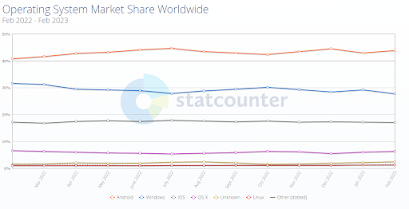
Window's market share is almost double that of Apple's OS, but it is blown out of the water by Android. Apple's OS and iOS combined bring them closer to Windows market share and what we see, is that Apple is already diversifying its platforms, while Windows is not. Windows could probably beef up its position in the market share ranking by including the functionality like that Winstep Nexus and Listary offer with little effort as long as the PC will be the still preferred, but waning, user choice, for which it has to seriously consider becoming a main player in the soaring mobile market in order to continue its dominance. An important aspect of this is porting Windows to ARM CPUs, which is a less successful undertaking by Microsoft, because it does not seem to be a priority in Redmond.

Catching up with current developments will not be easy since the Android train has already left the station at great pace and most likely this will not change in the near future, because mobile devices are more affordable than PCs and laptops. It does not require a genius mind to see in which direction platform preference is going. The Asian market already has a strong preference for mobile platforms and this will not change any time soon, because users have become familiar with the Android platform and apps, while ARM chips are becoming more powerful very fast. Is this the result of poor strategical judgement from Microsoft? Time will tell, although the sign on the wall seems to become more obvious as time passes.

PCs will remain the first choice for a number of applications that require large displays and a good measure of computing power, while needing keyboards and mice for accuracy and ease of operation. But many things can satisfyingly be done on mobile devices, including the all important web browsing and various types of messaging. So, different types of markets take away the need for a PCs and laptops, mainly when used for basic communication. While users spend more time on mobile devices and consequently less time on PCs, the industry that focuses on the latter must make working on PCs more effective and exploit the benefits of larger screens and more effective input devices (while it still makes sense). This is exactly the necessary potential that Microsoft has not attended to a level that would have been possible.

Traditionally a PCs were used in one or two specific locations most of the time - the office and / or at home. Making use of its potential in this market segment therefore is increasingly becoming imperative for PC manufacturers to survive as long as users can avoid the possibility to work anywhere. It is the reason why laptops became more popular and messaging communication became more important. However, a new development makes it possible to use (some) smartphones as a desktop PC replacement, which is an other potential nail in the PC market share coffin. And this device of course just marks the start of that type of innovation, that has the potential to even make laptops a thing of the past.

Many utilities that improve the default capabilities of platforms have a small footprint and could easily be integrated in those platforms, enhancing their usability and efficiency right out of the box. Today - March 2023 - Microsoft does not seem to feel a lot of urgency to incorporate useful utilities in their Windows system, but the landscape of computing is changing fast these days. Winstep Nexus and Listary are just two of the utilities that enhance the use of PCs significantly. Therefore, the direction in which the market is developing, should make PC platform manufacturers rethink their modus operandi if they plan to extend their market share while it still is possible to earn a decent sum of money in it. The deciding heart of the matter is the visionary talent of the company management. Spending too much time on keeping personnel on a short leash where salary fees and ignoring creative employee input are concerned, while partying on yachts is an unfailing recipe to ruin market share. Hubris and ignorance are dangerous mindsets when staying ahead of the competition is necessary to survive. Particularly in a world that shifts from bull market to bear market.

History has shown often enough that reluctance to adapt to market demand is preparation to the downfall of companies that failed to respond to it adequately. It is a feat that remains the same in a world of cyclical processes that supersedes companies' reluctance to adopt, laziness and / or inability to change their policy. However, in today's industrial world of competing monopolists, such a situation has almost always lead to unpleasant or even dystopian living conditions for those that don't have the power of decision. So perhaps diversity is a good thing after all, in view of the fact that power corrupts and lulls leadership into a false sense of still being on top and secure.....


Update September 29 2023

After the penultimate Windows 11 Update Listary refused to start and relatively long before that I uninstalled Nexus, because I found it less useful than I initially thought it would be and a little bit more buggy than I had anticipated. Nevertheless these programs could potentially fill some of the functional voids that were left unattended by Microsoft's developers. Software resembles a living thing; it either evolves or ceases to exist. Undoubtedly improved alternatives may emerge that make Windows users happy. Especially now that AI systems are able to write code for algorithms or programs, which efficiency and syntax puzzle developers, while they work better and faster than they could have thought of. Anyway, it was nice to have had a chance to at least get some idea of the, as of yet unfulfilled, potential of Listary and Nexus.